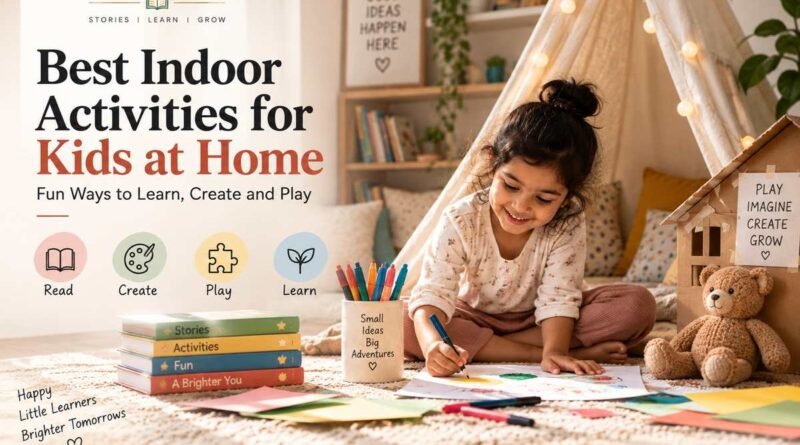
Best Indoor Activities for Kids at Home
There are days when children cannot spend much time outdoors. Rain, extreme heat, school holidays, travel or simply a busy family schedule can turn home into the main playground.
That does not mean children have to spend the day moving from one screen to another.
A home can become a surprisingly rich learning environment when children have opportunities to read, build, draw, imagine, experiment and create. The best indoor activities for kids do not require an elaborate setup. Often, a few books, paper, blocks, household materials and an interested adult are enough.
Quick Navigation
Turn reading into an activity
Reading is sometimes treated as a quiet activity that children do independently. It can become much more engaging when parents turn it into a conversation.
After reading a story, ask the child what they think the character should have done differently. Ask them to invent another ending or draw their favourite scene.
For younger children, parents can use picture books to discuss colours, animals, objects and emotions. Older children can write a short continuation of the story or create their own characters.
This makes children’s story books useful not only for developing reading habits but also for vocabulary, imagination and communication. Investing in best story books for children will work wonders to their mind and soul.
For families building a reading routine, even 15 to 20 minutes a day can become a meaningful part of the child’s schedule.

Create a small art corner
Children do not need expensive materials to make art.
Paper, crayons, pencils, coloured paper, cardboard boxes and safe craft materials can provide hours of creative exploration. One day, children might draw their favourite animal. The next, they might create a paper city or design a greeting card for a family member.
The objective should not always be producing something that looks perfect.
When children are allowed to experiment with art and craft activities for kids, they learn to make decisions independently. They choose colours, arrange shapes, solve small construction problems and develop patience while completing a project.
Build something
Construction activities are particularly useful because they combine imagination with problem-solving.
Give best educational toys for children such as children blocks, cardboard, magnetic pieces or other age-appropriate building materials and ask them to construct something specific: a bridge, house, vehicle, zoo or imaginary city.
Then introduce a small challenge.
Can the bridge hold three toy cars? Can the building be made taller? Can they create a house with two rooms?
Suddenly, an ordinary play session becomes an informal engineering exercise.
For families looking for screen-free activities for kids, building challenges are among the easiest to repeat because the same materials can create something completely different each time.
Bring science into the kitchen
Simple household experiments can make science tangible.
Children can observe which objects float or sink, investigate what happens when ice melts, compare how quickly different materials absorb water or grow a small plant and record its changes.
The activity does not need to become a formal science lesson. Asking children what they think will happen before an experiment is often enough to introduce prediction and observation.
For older children, age-appropriate science experiments for kids at home can become more structured, with children recording their observations and explaining the result.
Safety and adult supervision are essential, particularly when an experiment involves heat, sharp objects, chemicals or small components.
Play pretend
Pretend play is sometimes underestimated because it looks like “just playing.”
A cardboard box can become a shop. A table can become a restaurant. A collection of soft toys can become a classroom. Children can take turns being the teacher, customer, doctor, chef or shopkeeper.
These games allow children to practise language and social interaction while using imagination to create situations of their own.
Parents can participate without controlling the story. A simple question such as “What happens next?” can keep the child thinking.
Turn everyday tasks into challenges
Some of the most useful educational activities for kids are already available around the house.
Sorting laundry by colour can become a classification game. Counting spoons can introduce numbers. Measuring ingredients while cooking can introduce quantities. Organising books can become an opportunity to talk about authors, subjects and categories.
The advantage is that children begin to see learning as something that happens beyond school.
Make a simple activity routine
Indoor activities work best when children have some variety.
One day might focus on reading. Another could involve art or building. A weekend afternoon might be reserved for a board game or family storytelling.
The objective is not to fill every hour with structured activities. Children also need unstructured time to invent their own games.
Parents should resist the temptation to turn home into another classroom. The value of indoor play lies precisely in the freedom children have to explore ideas at their own pace.
A home can be a place of discovery
Children do not need a constant stream of new entertainment.
They need opportunities to use what they already have in different ways.
A story can become a drawing. A drawing can become a craft project. A cardboard box can become a spaceship. A puzzle can become a family competition. A cooking activity can become a mathematics lesson.
When parents provide this kind of environment, indoor activities for kids at home become more than ways to pass time. They become small opportunities for children to think, communicate, create and discover.
FAQs
What are some easy indoor activities for kids at home?
Reading, drawing, puzzles, building, pretend play, simple science experiments, board games and craft projects are easy options.
What are good screen-free activities for children?
Storytelling, books, construction toys, art, puzzles, board games and imaginative play can all provide engaging alternatives to screens.
How can parents make indoor activities educational?
Ask questions, encourage children to explain their thinking and introduce simple challenges instead of simply giving instructions.
Do indoor activities need special materials?
Not necessarily. Household objects, books, paper, cardboard, crayons and existing toys can support many activities.