Best Phonics Apps for Kids: A Guide for Parents of Early Readers
Learning to read involves more than recognising letters. Children need to understand how letters represent sounds, how sounds combine to form words, and how written words connect to spoken language. Phonics apps can help children practise these skills through interactive lessons, reading games and guided activities.
For parents in India, choosing the right app means considering the child’s age, reading ability, language needs and the way the app teaches phonics. Some tools introduce basic letter sounds, while others help children blend sounds, recognise spelling patterns and read short stories.
Here are five best phonics apps for kids worth exploring, along with practical advice for choosing one.
Quick Navigation
What Are the Best Phonics Apps for Kids?
The following apps offer different approaches to early reading. Their suitability depends on the child’s current skills and the kind of practice they need.
Duolingo ABC: For Beginners Learning to Read
Best for: Preschoolers and young children beginning to learn English reading.
Duolingo ABC offers short, interactive lessons covering phonics, letter recognition, handwriting, sight words and reading comprehension. Its activities use games and stories to introduce early literacy skills.
The app is designed for children learning foundational reading skills, with lessons that progress through different levels. It also supports offline learning.
Parents can consider Duolingo ABC when introducing children to letter sounds and early word recognition. Check device compatibility and availability in your region before downloading.
2. Google Read Along: For Reading Aloud
Best for: Children who know basic letters and need reading practice.
Google Read Along is a good educational app for kids. It provides illustrated stories and an in-app reading assistant that offers pronunciation support as children read aloud.
The service supports several languages, including English, Hindi, Telugu, Tamil, Marathi and Gujarati. Its Android app can work offline after the initial download and is available at no charge.
Read Along is particularly relevant for Indian families looking for reading practice in English or a supported Indian language. However, it is primarily a reading-practice tool rather than a structured phonics curriculum for complete beginners.
3. Teach Your Monster to Read: For Learning Through Games
Best for: Children who enjoy game-based reading activities.
Teach Your Monster to Read uses an adventure-game format to introduce early reading skills.
Its reading programme includes stages covering letter sounds, blending and word recognition. Children progress through activities designed to practise different parts of the early reading journey.
Parents looking for a more game-oriented approach may find this format engaging. Check the current version, device compatibility and pricing before choosing it, as availability and features may differ across platforms.
4. ZigZu: For Reading Practice with Indian English
Best for: Young readers who need guided English reading practice.
ZigZu is an AI-assisted reading coach designed for children aged 4 to 8, according to its Google Play listing.
The app describes features that listen as children read aloud, identify words they struggle with and provide phonics-based support. It also offers stories with Indian contexts.
Its focus on Indian English may be useful for families looking for reading practice that feels familiar to children learning English in India. Parents should review its current pricing, privacy information and features before deciding whether it suits their child.
5. Brolly Phonics: For Browser-Based Practice
Best for: Children who need practice with English letter sounds and spelling patterns.
Brolly Phonics offers browser-based phonics lessons and games. Its activities cover skills ranging from individual letter sounds to more advanced spelling patterns.
The browser-based format may suit families who prefer not to install another mobile app. Parents should check the curriculum, pronunciation model and lesson progression to ensure they align with the child’s learning needs.
How to Choose the Right Phonics App
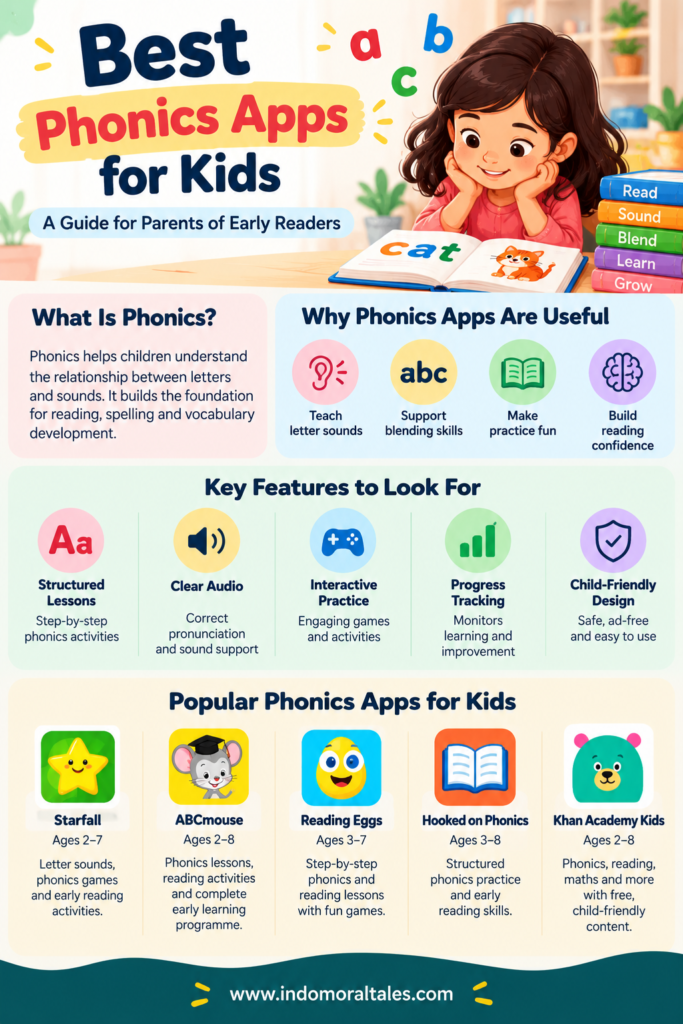
Before downloading an app, consider these five factors.
1. Start with Your Child’s Reading Stage
A child who is just learning the alphabet needs different activities from one who can already recognise letter sounds.
Look for lessons that progress logically from sound recognition to blending, word reading and simple sentences. If an app is consistently too difficult or too easy, it may not provide useful practice.
2. Check How Phonics Is Taught
A good phonics learning resource should help children understand the relationship between letters and sounds. Activities should allow them to practise blending sounds into words rather than relying entirely on pictures or guessing.
Look for clear explanations, repeated practice and feedback that helps children understand mistakes.
3. Consider Language and Pronunciation
Children in India may speak one language at home and learn to read English at school. Choose an app that supports the language and pronunciation model appropriate for your child’s needs.
If your child is learning to read in an Indian language, verify that the app actually teaches reading in that language. An app offering multilingual stories does not necessarily provide a complete phonics curriculum for every supported language.
4. Review Privacy and Costs
Check the app’s privacy policy, advertising practices, in-app purchases and subscription terms. For children’s apps, also review the permissions requested and whether parental controls are available.
Free apps can offer useful practice, while paid products may include additional lessons or progress features. Compare what is included before subscribing.
5. Balance Digital Practice with Reading Together
Apps can provide repeated practice, but children also need opportunities to read printed books, listen to stories and talk about what they read.
Spend time reading with your child. Ask them to identify familiar sounds, explain a story or find words beginning with a particular letter. These activities connect digital practice with everyday reading.
Frequently Asked Questions
At what age should children start using phonics apps?
Some children begin exploring letter sounds during preschool, but readiness varies. Choose activities appropriate to the child’s development and introduce them alongside conversation, books and play.
Can phonics apps help children learn to read?
Phonics apps can provide practice with letter sounds, blending and word recognition. Their usefulness depends on the quality of instruction, the child’s needs and how the activities complement other reading experiences.
Are free phonics apps available for children in India?
Yes. Duolingo ABC and Google Read Along offer free learning experiences. Their features and teaching approaches differ, so parents should select one according to the child’s reading stage.
Should children use phonics apps without adult supervision?
Independent practice may be appropriate for some children, but younger learners often benefit from adult guidance. Parents can help explain unfamiliar words, encourage reading aloud and check whether the child understands the activity.
Final Thoughts
The best phonics app is one that meets your child’s current reading needs and encourages steady progress.
Start by identifying the skill your child needs to practise, whether it is letter sounds, blending or reading aloud. Compare the available tools, review their privacy practices and observe how your child responds.
Most importantly, treat phonics apps as a supplement to shared reading, conversation and structured learning, not a replacement for them.