
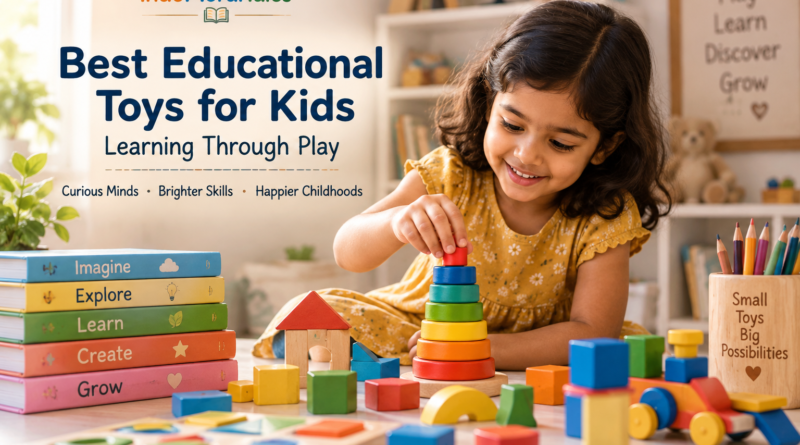
Best Educational Toys for Kids: Learning Through Play
A good toy does more than keep a child occupied. It can encourage a child to ask questions, experiment, make mistakes, solve problems and try again.
That is why best educational toys for kids have become increasingly important to modern parents. Instead of separating learning from play, these toys bring the two together. A child building a tower is learning about balance. A child completing a puzzle is practising logical thinking. A child creating a model with a craft kit is making decisions, solving small problems and expressing an idea.
India’s educational-toy market is also expanding as parents increasingly look for products that combine entertainment with skill development. IMARC estimates that the Indian educational toys market reached about US$2.33 billion in 2025 and projects continued growth through 2034. The market includes building sets, STEM toys, art and craft kits, games, puzzles and role-play products.
Quick Navigation
What makes a toy educational?
An educational toy does not necessarily have to look like a classroom product.
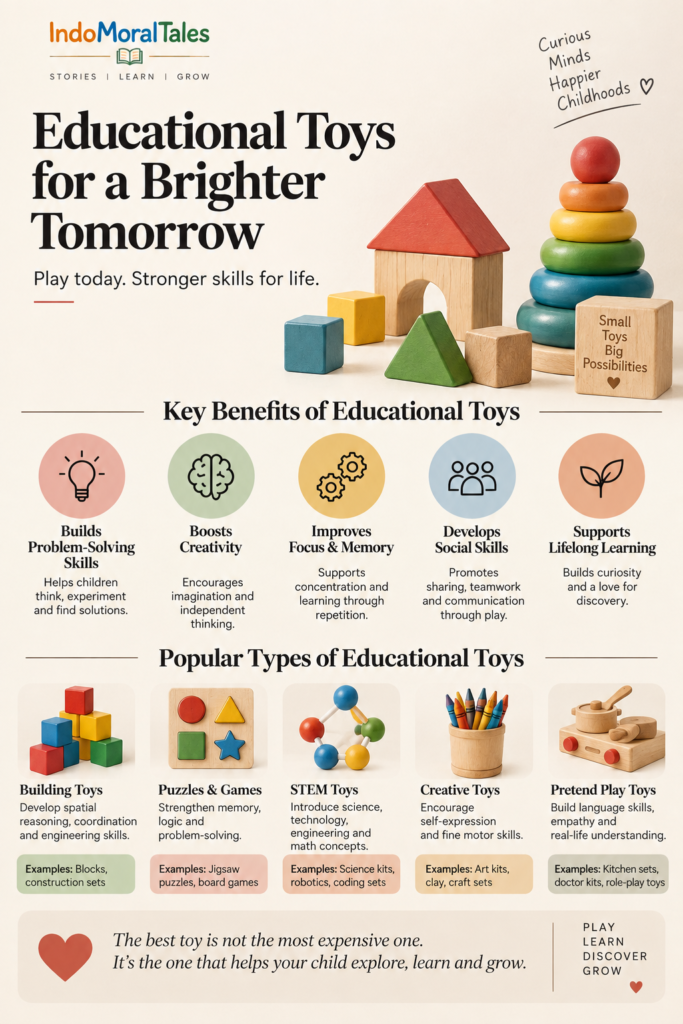
In fact, some of the simplest toys can create meaningful learning experiences. Building blocks can develop spatial reasoning. Matching games can strengthen memory and observation. Pretend-play sets can encourage language and social interaction. Art materials can give children opportunities to make choices rather than simply follow instructions.
The most useful learning toys for children usually have one thing in common: they allow children to do something rather than simply watch something happen.
This distinction matters in an age when children have access to an enormous amount of passive digital entertainment. Recent retail trends in India also suggest growing parental interest in hands-on alternatives. Amazon India reported strong growth in STEM and learning toys such as science and craft kits, building sets, board games and puzzles in several regional markets.
Choosing educational toys by age
For toddlers, simple construction toys, stacking activities, shape sorters, large-piece puzzles and pretend-play materials can be more appropriate than complicated electronic products. At this stage, children are discovering cause and effect, coordination, language and basic problem-solving.
For preschoolers, the range can expand. Educational toys for toddlers and preschoolers can include magnetic construction sets, beginner puzzles, counting games, drawing materials, pretend-play kits and simple science activities.
Once children enter the early school years, parents can introduce more structured challenges. Building sets, strategy games, geography games, science experiment kits and age-appropriate STEM toys for kids can encourage children to explore subjects that may otherwise feel abstract.
The important principle is not to choose the most sophisticated toy. It is to choose one that matches the child’s developmental stage and interests.
Building, creating and solving
Three broad categories are particularly useful when parents are looking for meaningful play.
Building toys encourage children to imagine an outcome and work towards it. Blocks, construction sets and model-building activities can introduce ideas related to balance, structure, measurement and spatial relationships.
Creative toys work differently. Drawing, painting, clay modelling, craft kits and musical activities give children a chance to produce something of their own. There is no single correct answer, which makes these activities particularly useful for creativity and self-expression.
Then there are games and puzzles. These encourage children to observe, remember, plan and make decisions. Some also introduce early mathematical reasoning, vocabulary or pattern recognition without making the experience feel like homework.
This is where educational games for children can become particularly valuable for families trying to create screen-free routines.
The toy matters, but the interaction matters more
Parents sometimes expect an educational toy to teach a child automatically. In reality, the adult’s involvement can make the experience considerably richer.
A parent might ask, “What do you think will happen if we make this taller?” while building blocks together. During a puzzle, instead of immediately giving the answer, they might ask the child to look for a particular shape or colour.
The toy becomes a starting point for conversation.
That is also why expensive or technology-heavy toys are not necessarily better. A simple building set can remain interesting for years because the child can use it differently as their imagination and abilities develop.
What should parents look for?
Safety should come before educational claims. Parents should check age recommendations, construction quality, material information and relevant safety standards before buying.
It is also worth considering whether the toy can be used in multiple ways. An open-ended toy that encourages children to invent different games may offer more long-term value than a product designed around one fixed activity.
Storage, durability and the amount of adult supervision required are practical considerations too.
Most importantly, choose something that connects with the child’s curiosity. A child fascinated by animals may learn more from an animal-themed puzzle or model-building activity than from a supposedly advanced toy that does not interest them.
Learning does not have to feel like learning
The strongest educational toys are often the ones children forget are educational.
A puzzle becomes a challenge. A construction set becomes a city. A science kit becomes an experiment. A storybook becomes an adventure.
That is the real value of learning through play. Children are not simply receiving information. They are interacting with ideas.
For parents, the goal should therefore be less about finding the “perfect” educational toy and more about creating opportunities for children to play, explore, create and think.
FAQs
What are the best educational toys for kids?
Building sets, puzzles, STEM kits, art materials, board games and age-appropriate pretend-play toys can all support different areas of development.
Are educational toys useful for toddlers?
Yes. Simple stacking, sorting, matching, construction and pretend-play activities can support coordination, language and early problem-solving.
Are STEM toys suitable for young children?
Yes, provided the product is designed for the child’s age. STEM learning for younger children can begin with simple building, observation, counting and cause-and-effect activities.
Do educational toys reduce screen time?
They can contribute to a more varied routine, particularly when children have engaging hands-on alternatives. The goal should be balanced use rather than treating every screen-based activity as harmful.


Pingback: Best Indoor Activities for Kids at Home: Fun & Learning
Pingback: 5 Storytelling Activities to Build Language Skills in Preschoolers