Best Maths Learning Apps for Primary School Students
Mathematics becomes easier to understand when children can practise concepts, explore visual examples and learn from mistakes. Maths learning apps can support this process by turning addition, multiplication, fractions and problem-solving into interactive activities.
For parents in India, choosing the right app involves more than finding games that keep children occupied. The app should match the child’s class level, support meaningful practice and, where possible, complement the school curriculum.
Here are five best maths learning apps for primary school students worth exploring, along with practical guidance on choosing one for your child.
Quick Navigation
What Are the Best Maths Learning Apps for Primary School Students?
1. Khan Academy Kids: Best for Building Early Maths Skills
Suitable for: Preschool to approximately Grade 2.
Khan Academy Kids offers early maths activities covering counting, number relationships, addition, subtraction, shapes, patterns and problem-solving.
The app uses stories, visual models and interactive exercises to help young children understand basic mathematical concepts. It is free to use and does not display advertisements.
Khan Academy Kids is worth considering for children who are developing number sense and learning foundational arithmetic. Its early-learning focus makes it less suitable as a standalone resource for older primary students studying more advanced topics.
2. Building Blocks by Akshara Foundation: Best for Indian School Mathematics
Suitable for: Grades 1 to 8.
Building Blocks is a maths learning app developed by Akshara Foundation, an Indian education-focused nonprofit.
The app provides interactive maths games designed to reinforce concepts taught at school. According to its Google Play listing, it covers Grades 1 to 8, includes more than 400 activities and supports multiple Indian languages. Its content is mapped to the National Curriculum Framework 2023.
The app is free and does not include advertisements or in-app purchases, according to the listing.
For Indian families, its school-oriented approach and regional-language support are useful features to consider. Parents should check the supported language and grade coverage for their child’s specific needs.
Check Best Phonic Apps for Kids
3. SplashLearn: Best for Game-Based Maths Practice
Suitable for: Preschool to Grade 5.
SplashLearn combines maths practice with interactive games and activities. Its maths content includes counting, arithmetic, place value, fractions, geometry, measurement and word problems.
The platform is designed for home and classroom use, with activities covering different learning levels. It also provides worksheets and progress-related features.
SplashLearn may suit children who respond well to visual activities and structured practice. However, parents should review the available free content, subscription requirements and features included in each plan before signing up.
4. Tivumo: Best for Visualising Mathematical Concepts
Suitable for: Grades 3 to 12, according to its Google Play listing.
Tivumo presents mathematical ideas through interactive visual models. Children can manipulate representations such as fraction bars, arrays and graphs rather than relying entirely on written calculations.
Its listed curriculum includes topics such as place value, division, fractions, decimals, geometry and percentages. The app is designed for Indian classrooms and supports English, Hindi and Marathi in its menus and explanations, although some in-game questions remain in English.
Tivumo may be useful for children who struggle to understand abstract concepts from textbook explanations alone. Because its Google Play listing identifies it as a newer release, parents should explore the available lessons and confirm that the required topics are covered before relying on it.
5. Khan Academy: Best for School-Level Maths Learning
Suitable for: School students in Grades 1 to 12.
Khan Academy India offers free educational resources aligned with the Indian curriculum. Its maths resources cover school-level concepts and include instructional material and practice activities.
The platform supports several languages, including English, Hindi, Hinglish, Gujarati, Marathi, Kannada, Punjabi, Assamese and Odia.
For primary school students, parents can use it to revisit classroom concepts, practise skills and build understanding at an appropriate pace. Check the available course material against the child’s current syllabus, as course coverage and language availability may vary.
How to Choose the Right Maths App for Your Child
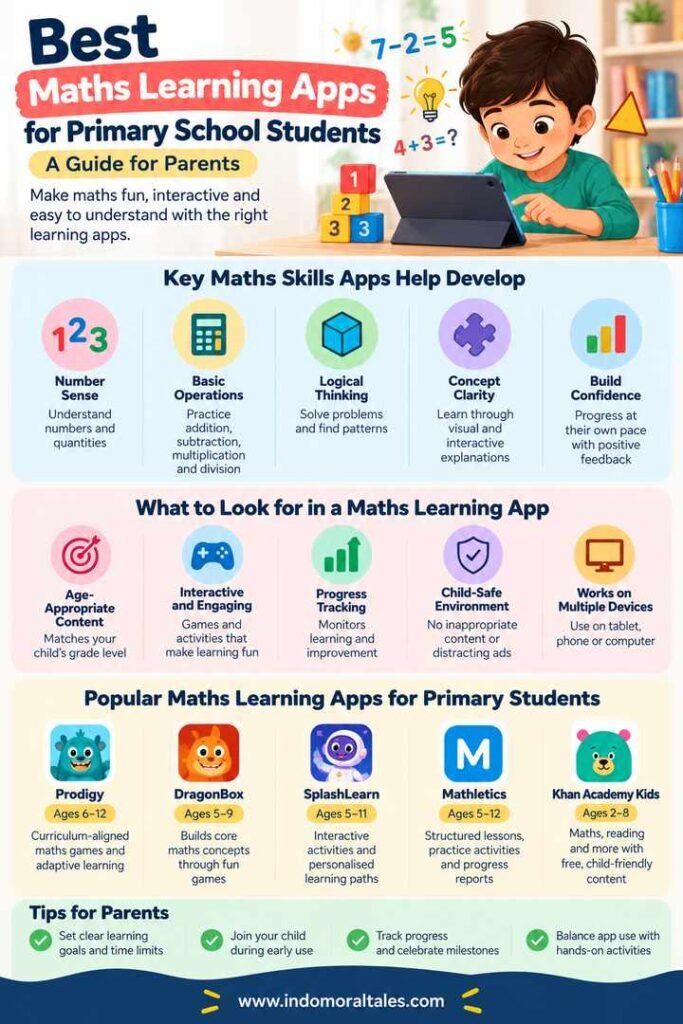
Not every maths app suits every learner. Consider these five factors before downloading one.
1. Match the App to the School Grade
A child in Grade 1 may need help recognising numbers and understanding addition, while a Grade 5 student may be practising fractions, decimals and multi-step word problems.
Check the app’s grade coverage and lesson progression. Choose activities that reinforce what the child is learning at school rather than introducing unnecessary complexity.
2. Look for Conceptual Understanding
An app should do more than ask children to select answers quickly.
Visual representations, worked examples, hints and explanations can help children understand why a method works. These features are particularly useful when learning fractions, place value or multiplication.
3. Check Curriculum Relevance
Indian schools may follow CBSE, ICSE or state-board curricula. Before choosing a paid platform, compare its topics with the child’s school syllabus.
Curriculum alignment can make an app more useful for revision, but it does not automatically guarantee that every lesson matches the school’s teaching sequence.
4. Review Cost and Privacy
Check subscription prices, renewal terms, advertising practices, in-app purchases and account requirements.
Parents should also review the privacy policy and permissions requested by the app. For children’s digital products, clear data practices and appropriate parental controls matter as much as attractive learning activities.
5. Balance Screen-Based Learning with Practical Activities
Children can reinforce maths concepts away from a device. Ask them to calculate the cost of items while shopping, divide fruit equally among family members, measure ingredients or identify shapes around the house.
These everyday experiences help children connect mathematical ideas with practical situations.
Frequently Asked Questions
Which maths app is best for primary school students in India?
The best choice depends on the child’s grade and learning needs. Building Blocks by Akshara Foundation focuses on school mathematics for Grades 1 to 8. SplashLearn offers game-based practice, while Khan Academy provides broader educational resources aligned with the Indian curriculum.
Are free maths learning apps available for children?
Yes. Khan Academy Kids, Khan Academy and Building Blocks offer free learning resources. Their subject coverage, grade levels and teaching approaches differ, so parents should compare them before choosing.
Can maths apps help children who struggle with mathematics?
Apps can provide additional practice, visual explanations and opportunities to revisit difficult concepts. However, persistent difficulties may require individual guidance from a teacher or qualified educator.
How long should children use maths learning apps?
There is no single duration suitable for every child. Keep sessions purposeful and age-appropriate, and ensure digital learning does not displace sleep, physical activity, play or other important routines.
Final Thoughts
The best maths learning app is one that helps a child understand mathematical concepts, practise at the right level and develop confidence without unnecessary pressure.
Start with the topic your child needs to learn, compare the available resources and observe whether the activities improve understanding. Combine digital practice with schoolwork, hands-on activities and support from parents or teachers.
The objective is not to spend more time on a device. It is to help children understand mathematics well enough to use it independently.