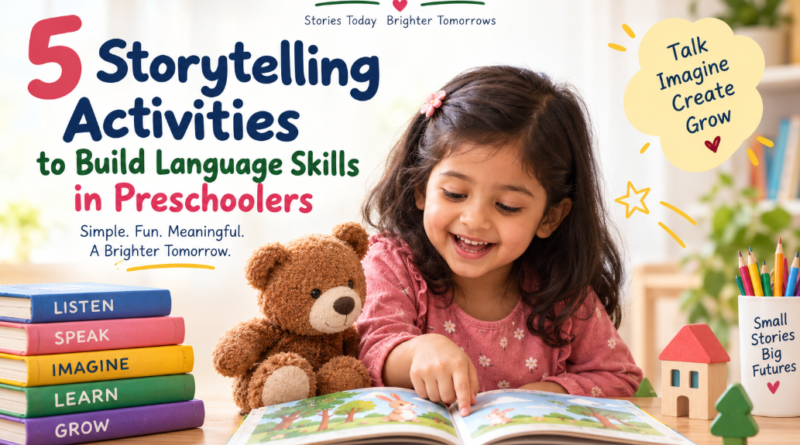
5 Storytelling Activities to Build Language Skills in Preschoolers
Language development in the preschool years is shaped by everyday interactions. A conversation during breakfast, a question about a picture book, or a child retelling a familiar story can create opportunities to build vocabulary, strengthen listening skills, and develop confidence in speaking.
Storytelling is particularly useful because it combines language with imagination, memory, expression, and social interaction. Children are not simply listening to words. They are learning how stories are structured, how ideas connect, and how language can be used to describe experiences and communicate meaning.
For parents, preschool teachers, and early childhood educators, storytelling activities offer a practical way to support language learning without turning it into a formal lesson.
Here are five storytelling activities for preschoolers that encourage active participation while developing essential early language skills.
Quick Navigation
Why Storytelling Matters for Preschool Language Development
Storytelling gives children opportunities to hear language in context and use it for meaningful communication. Unlike isolated vocabulary exercises, stories connect words with characters, actions, emotions, and events.
Regular, interactive storytelling can support several areas of early language development:
- Vocabulary development: Learning new words and understanding how they are used.
- Listening skills: Paying attention to spoken language and following a sequence of events.
- Narrative skills: Describing what happened, connecting ideas, and retelling stories.
- Expressive language: Using words and sentences to share thoughts, experiences, and imagination.
- Comprehension: Understanding characters, actions, causes, and outcomes.
Research on dialogic reading, an interactive approach to shared book reading, has found positive effects on oral language among preschool children. The approach encourages children to participate as storytellers while adults ask questions, listen, and expand their responses.
The objective is not to make every storytelling session instructional. Children learn through engaging conversations, repetition, and opportunities to express themselves.
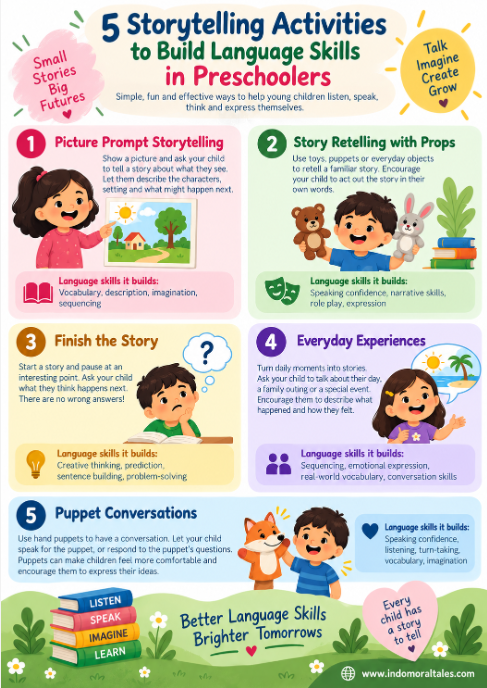
1. Picture Prompt Storytelling
Activity: Create a Story from Pictures
Picture prompt storytelling is a simple language development activity for preschoolers that uses illustrations or photographs to encourage children to construct their own stories.
You can use picture cards, magazine cutouts, children’s drawings, or a series of everyday photographs.
How to do it
- Select three to five pictures showing people, animals, objects, or events.
- Place the pictures in front of the child.
- Ask the child to observe each picture and describe what they see.
- Encourage the child to arrange the pictures into a sequence.
- Invite them to tell a story connecting the images.
For example, a series of pictures might show a boy finding a seed, planting it, watering the soil, and seeing a small plant grow.
Ask:
- What is happening in this picture?
- What do you think happened first?
- What might happen next?
- How does the boy feel?
- Can you tell me the whole story?
Language skills developed
- Vocabulary and descriptive language
- Sequencing and narrative development
- Sentence formation
- Observation and comprehension
- Creative thinking
Parent and teacher tip: Avoid correcting every sentence. Instead, model more complete language. If a child says, “Boy water plant,” you could respond, “Yes, the boy is watering the plant because he wants it to grow.”
This approach provides a natural example of how to expand a child’s spoken language without interrupting the storytelling experience.
2. Story Retelling with Props
Activity: Bring a Familiar Story to Life
Children often enjoy repeating stories they already know. Retelling a familiar story with puppets, soft toys, paper characters, or household objects gives them a chance to participate actively rather than simply listen.
Choose a short story with a clear beginning, middle, and end. Stories involving animals, family experiences, or simple adventures can be adapted to the child’s interests.
How to do it
- Read or tell a short story together.
- Introduce two or three props representing the main characters.
- Ask the child to identify the characters and recall what happened.
- Encourage the child to act out the story using the props.
- Allow the child to change the characters’ dialogue or create a different ending.
For example, after a story about a rabbit looking for its lost carrot, the child can use a toy rabbit and other objects to recreate the search.
Useful prompts include:
- Who is the main character?
- Where did the rabbit go?
- What problem did it have?
- What did the rabbit do next?
- How did the story end?
Language skills developed
- Story comprehension
- Recall and sequencing
- Action words and descriptive vocabulary
- Dialogue and conversational language
- Confidence in oral expression
Retelling encourages children to reconstruct a story in their own words. Shared reading research indicates that interactive discussion and narrative-focused activities can support vocabulary and narrative comprehension.
Parent and teacher tip: Let the child retell the story differently from the original. The goal is to encourage communication and understanding, not memorised reproduction of every sentence.
3. Finish the Story
Activity: What Happens Next?
Finish the Story is an imaginative storytelling game in which an adult introduces a short scenario and invites children to decide how it continues.
This activity helps children practise predicting, explaining, and connecting ideas. It can be done during circle time, at home, or as a short group activity in preschool.
How to do it
Begin with a simple opening:
“One morning, Mia found a tiny door behind a tree. When she opened it, she heard a strange sound…”
Pause and let the child continue.
Ask:
- What do you think is behind the door?
- Who might be making the sound?
- What will Mia do next?
- What happens after she opens the door?
- How does the story end?
You can introduce different themes depending on the child’s age and interests, such as a lost puppy, a flying bicycle, a rainy-day adventure, or a mysterious box.
For younger preschoolers, offer two or three possible choices. Older preschoolers may enjoy developing an entire sequence of events.
Language skills developed
- Expressive language
- Predictive thinking
- Cause-and-effect reasoning
- Vocabulary development
- Imagination and narrative structure
The Education Endowment Foundation recommends incorporating storytelling, shared reading, and intentional vocabulary development into rich early-years learning experiences. It also highlights the importance of providing opportunities for children to hear and use new vocabulary repeatedly.
Parent and teacher tip: Accept imaginative answers even when they differ from what you expected. Follow up with questions such as “Why do you think that happened?” to encourage the child to explain their ideas.
4. Storytelling Through Everyday Experiences
Activity: Turn Daily Moments into Stories
Storytelling does not require a storybook, prepared lesson, or special materials. Everyday experiences can become opportunities for children to describe events, learn vocabulary, and practise speaking in sequence.
A visit to a park, a trip to the grocery store, a family meal, or a rainy afternoon can provide the basis for a short conversation.
How to do it
Choose a recent experience that the child remembers. Encourage them to describe what happened using simple prompts.
For example, after visiting a park, ask:
- Where did we go?
- What did you see first?
- Who was playing there?
- What did you enjoy most?
- What happened before we came home?
You can also encourage the child to draw a picture of the experience and explain it.
If the child says, “I saw a dog,” extend the conversation:
“Yes, you saw a small brown dog near the slide. What was the dog doing?”
This adds descriptive language and encourages the child to provide more information.
Language skills developed
- Everyday vocabulary
- Sentence construction
- Recalling personal experiences
- Listening and conversational turn-taking
- Descriptive and expressive language
Children benefit from language-rich interactions that are responsive to their interests and experiences. Early language guidance emphasises the value of meaningful verbal interaction and opportunities to use vocabulary in different contexts.
Parent and teacher tip: Give the child enough time to respond. Avoid completing every sentence or immediately supplying the answer. A short pause can create space for the child to organise their thoughts.
5. Puppet Conversations and Character Voices
Activity: Let the Puppets Tell the Story
Puppet storytelling combines pretend play with conversation. Children can speak through a character, respond to another puppet, or create a short dialogue between two imaginary figures.
This activity can be particularly useful for encouraging children who enjoy role-play or prefer participating through play rather than answering direct questions.
How to do it
Use hand puppets, paper-bag puppets, soft toys, or simple character drawings. Introduce two characters and give them a situation.
For example:
- A rabbit wants to borrow a book from a friend.
- A bear has lost its favourite toy.
- Two animals are planning a picnic.
- A bird wants to learn how to fly.
Invite the child to choose one character and the adult to play the other.
Begin with a simple exchange:
Puppet 1: “Hello! What are you looking for?”
Puppet 2: “I am looking for my red ball.”
Then encourage the child to continue the conversation.
Questions and prompts can include:
- What does your character want?
- How does the character feel?
- What could the other character say?
- Can the characters solve the problem together?
- What happens at the end?
Language skills developed
- Conversational turn-taking
- Vocabulary and sentence formation
- Emotional expression
- Social communication
- Imaginative and narrative language
Interactive storytelling gives children opportunities to express ideas, listen to another speaker, and adapt their language to a fictional situation. The learning value comes from the quality of interaction rather than the complexity of the props.
Parent and teacher tip: Allow the child to choose the character and guide the direction of the conversation. Offer language models when needed, but leave room for the child to create original dialogue.
How to Make Storytelling More Effective for Preschoolers
The activity matters, but the way adults interact with children during storytelling matters as well. A supportive approach can turn a short story into a meaningful language-learning experience.
1. Ask open-ended questions
Instead of asking only questions with a yes-or-no answer, encourage children to describe, explain, and predict.
| Less open-ended | More open-ended |
| Is the dog happy? | How do you think the dog feels? |
| Is this a tree? | What can you tell me about the tree? |
| Did the boy run? | What did the boy do when he heard the sound? |
Open-ended questions should be appropriate to the child’s age and language abilities. Younger children may need simple prompts, while older preschoolers can respond to questions about motives, consequences, and story endings.
2. Introduce new vocabulary in context
Choose a few useful words from the story. Explain their meaning using pictures, actions, or familiar examples.
For example:
- Enormous: Something very large.
- Exhausted: Very tired.
- Discover: To find something you did not know about before.
Use the new words again during the activity. Repeated exposure and opportunities to use vocabulary help children develop both the number of words they know and their understanding of how words work in context.
3. Encourage children to retell stories
Ask children to describe what happened in their own words. They may leave out details, change events, or tell a shorter version. This is a natural part of learning to organise and express ideas.
You can support the retelling by asking:
- What happened at the beginning?
- What happened next?
- How did the character solve the problem?
- What happened at the end?
4. Use repetition without making it monotonous
Young children often enjoy listening to the same story multiple times. Repeated readings can provide additional opportunities to anticipate events, recall vocabulary, and participate in familiar sections.
During the first reading, focus on enjoyment and understanding. During later readings, invite the child to fill in a phrase, describe a picture, or retell part of the story.
5. Include the child’s home language
Storytelling can take place in the language or languages that a child and family use comfortably. Parents can tell stories in their home language, discuss pictures, and encourage children to share experiences in the language they know best.
The priority is meaningful communication and a rich language environment. Families do not need to restrict storytelling to English to make the activity valuable.
A Simple Weekly Storytelling Plan
Parents and preschool teachers can use the following schedule to introduce variety without making storytelling feel repetitive.
| Day | Activity | Primary focus |
| Monday | Picture prompt storytelling | Vocabulary and description |
| Tuesday | Story retelling with props | Recall and sequencing |
| Wednesday | Finish the story | Imagination and prediction |
| Thursday | Everyday experience storytelling | Conversation and expression |
| Friday | Puppet conversations | Dialogue and social communication |
A session does not need to be long. The appropriate duration depends on the child’s age, interest, attention, and developmental needs. Consistent, responsive interactions are more useful than forcing a child to complete a fixed activity.
Benefits of Storytelling Activities for Preschoolers
Storytelling supports language learning by giving children repeated opportunities to listen, speak, interpret, and express ideas. The specific benefits will vary depending on the child’s developmental stage, the quality of adult interaction, and the frequency of meaningful language experiences.
Key benefits include:
- Improved vocabulary: Children encounter new words through stories, conversations, and descriptions.
- Stronger listening skills: Children practise attending to spoken language and following events.
- Better narrative understanding: Children learn to connect events and describe what happened.
- Increased speaking confidence: Children gain opportunities to share ideas in a supportive environment.
- Enhanced imagination: Children explore fictional situations, characters, and alternative outcomes.
Evidence from research on interactive shared reading supports its use in early language and literacy learning, although individual outcomes differ and storytelling is one component of broader early childhood development.
Frequently Asked Questions About Storytelling for Preschoolers
1. What are the best storytelling activities for preschoolers?
Picture prompt storytelling, story retelling with props, finishing an incomplete story, describing everyday experiences, and puppet conversations are five practical activities. Each encourages children to participate in spoken language and can be adapted to their age and interests.
2. How does storytelling help language development in preschoolers?
Storytelling exposes children to vocabulary, sentence structures, narrative sequences, and conversational exchanges. When adults ask questions and encourage children to retell or create stories, children have opportunities to practise understanding and expressing language.
Interactive reading research has reported positive effects on preschool children’s oral language, including vocabulary-related outcomes.
3. How long should a storytelling activity last?
There is no single ideal duration for every preschooler. Start with a short activity that matches the child’s attention span and interest. Some children may participate for a few minutes, while others may remain engaged longer. Follow the child’s responses and adjust the activity accordingly.
4. Can storytelling improve a child’s vocabulary?
Storytelling can support vocabulary development by introducing new words in meaningful contexts. Children benefit when adults explain unfamiliar words, use them in conversation, and provide additional opportunities to hear and use them. Vocabulary development is strengthened by a broader language-rich environment rather than a single activity alone.
5. Can parents use storytelling activities at home?
Yes. Parents can use picture books, toys, family experiences, household objects, and everyday conversations to create storytelling opportunities. No specialised equipment is required. Telling stories in a familiar home language can also support meaningful communication.
6. What if a preschooler is reluctant to tell stories?
Begin with activities that require less verbal output, such as pointing to pictures, choosing a character, completing a familiar phrase, or acting out a story with toys. Offer encouragement without forcing the child to speak. If concerns about a child’s language development persist, parents should discuss them with a qualified paediatrician, speech-language professional, or relevant early childhood specialist.
Conclusion
Storytelling is a practical way to integrate language development into a preschooler’s everyday experiences. Whether a child is describing a picture, acting out a familiar story, inventing an adventure, or speaking through a puppet, each activity can create opportunities for communication and imaginative expression.
The most effective storytelling experiences are interactive. Adults listen, ask relevant questions, introduce vocabulary, and give children time to develop their own ideas.
A story does more than entertain a child. It gives the child a reason to listen, speak, imagine, and connect with the world through language.
Start with one activity, follow the child’s interests, and make storytelling a regular part of learning and play.