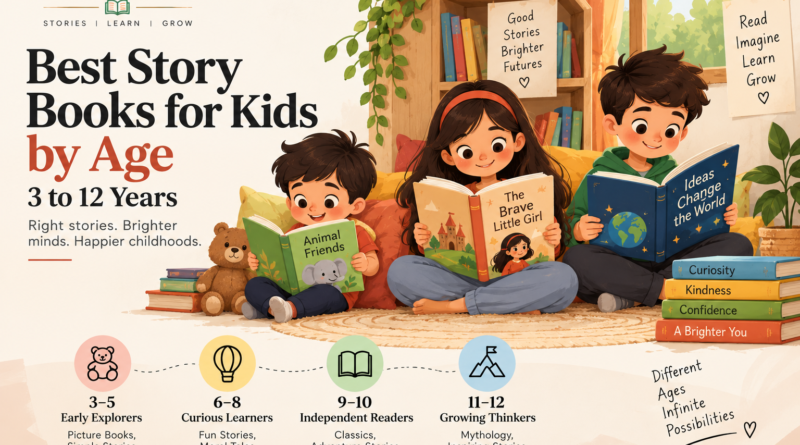
Best Story Books for Kids by Age: A Guide for Children Aged 3 to 12
A child does not need to read the most difficult book available to become a good reader.
The better approach is to find stories that meet children where they are: books with an appropriate level of language, themes that interest them and enough room for imagination.
For a three-year-old, a beautifully illustrated story read aloud by a parent may be more meaningful than a book designed for independent reading. By eight or nine, a child may be ready for longer narratives with several characters and more complicated plots.
That is why choosing children’s books by age can be useful, even though age should never be treated as a strict rule.
India’s publishing ecosystem is also expanding. A 2026 report from the Federation of Indian Publishers and NielsenIQ BookData projected India’s overall book publishing market could approach ₹2 lakh crore by 2030–31, up from around ₹1.08 lakh crore in 2024–25.
For parents, that growing market means more choice. The challenge is knowing what kind of story is right for a particular child.
Quick Navigation
Ages 3–4: Read aloud and explore
At three and four, children are still developing vocabulary, attention and an understanding of narrative.
Picture books, short animal stories, repetitive stories, nursery tales and simple moral stories work particularly well. Books with strong illustrations can help children understand the story even when they cannot yet read the words themselves.
This is also an excellent age for parents to pause and ask questions.
“What do you think the rabbit will do?”
“Why is the character sad?”
“What would you have done?”
A story therefore becomes a conversation rather than a one-way reading exercise.
Ages 5–6: Stories with repetition and simple lessons
Children entering school often begin developing greater independence with books.
Short chapters, illustrated story collections, fairy tales, folk stories and simple moral stories for kids can work well at this stage.
Indian stories are particularly valuable here because they can introduce children to familiar cultural settings, festivals, animals, historical figures and traditional storytelling.
Panchatantra tales, Tenali Raman stories, Akbar and Birbal stories and age-appropriate stories from Indian epics can provide entertaining narratives while introducing ideas about wisdom, kindness, courage, responsibility and consequences.
The important point is to avoid turning every story into a lecture about morality. Children should first experience the story as a story.
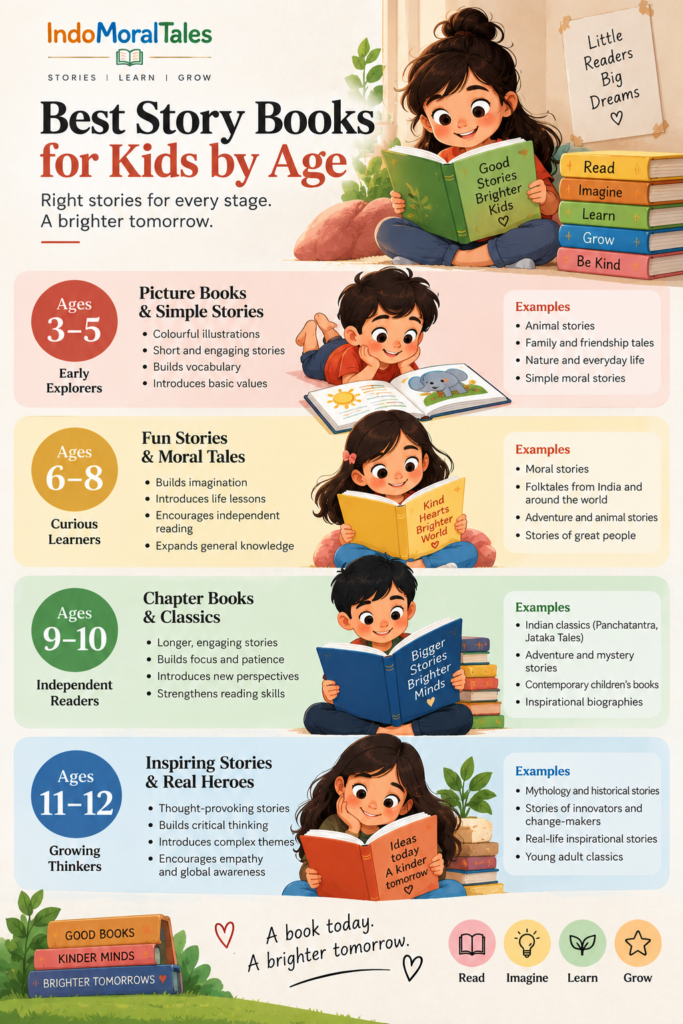
Ages 7–8: Longer stories and wider worlds
At seven and eight, many children can follow more complex plots.
This is a good stage to introduce collections of Indian children’s books, classic children’s literature, adventure stories, mythology adapted for children and longer folk tales.
Children may begin to develop preferences of their own. Some want animals and fantasy. Others prefer humour, mysteries or stories about school and friendships.
Parents can use this stage to broaden reading without removing choice. A child who loves adventure might happily try a historical story if it is presented through an engaging narrative.
Ages 9–10: Independent reading and chapter books
By nine and ten, many children are ready for books with larger casts of characters, longer chapters and more developed themes.
Adventure, fantasy, mystery, mythology, historical fiction and age-appropriate biographies can all work well.
This is also a useful stage for introducing children to authors from different parts of India and different literary traditions.
Reading should increasingly become something the child chooses to do independently. Parents can still discuss books, but they do not need to test the child after every chapter.
A simple question such as “What did you think of the character?” can be enough to keep the conversation alive.
Ages 11–12: Complexity, identity and perspective
Older children can handle more nuanced stories.
Books can introduce themes such as friendship, identity, courage, family relationships, social responsibility and ethical choices, provided the content is appropriate for the child’s maturity.
At this age, children can also explore different genres rather than being limited to books labelled specifically for younger readers.
A good story book for kids aged 10 to 12 should not necessarily feel childish. Humour, adventure, fantasy, mythology, science fiction and realistic fiction can all find a place on the reading list.
Should children read only Indian stories?
No. A strong reading habit benefits from variety.
Indian folk tales and mythology can connect children with cultural traditions and storytelling forms. International classics can introduce different settings, characters and perspectives. Contemporary children’s literature can reflect experiences that feel closer to a child’s everyday life.
The aim is not to choose between Indian and international literature.
It is to create a reading shelf broad enough for children to discover what they enjoy.
How parents can build a reading habit
The simplest strategy is consistency.
A child does not need to finish a book every day. A regular bedtime reading routine, a weekly library visit or a quiet reading period after school can gradually make books part of everyday life.
Parents can also let children abandon a book that genuinely does not interest them. Reading should not become associated entirely with obligation.
And sometimes the best way to encourage a child to read is for them to see adults reading too.
The right book is the one that opens another door
A good children’s book does more than occupy a few minutes.
It can introduce a new character, question an assumption, create curiosity about another place or encourage a child to imagine an entirely different world.
That is why the best story books for kids are not necessarily the longest, most expensive or most educational-looking books.
They are the books children want to return to.
When parents choose books according to age, interest and reading ability, they give children something more valuable than a reading list: the possibility of developing a lifelong relationship with stories.
FAQs
What are the best story books for 3-year-old children?
Picture books, short animal stories, repetitive narratives and simple read-aloud stories are generally suitable.
Which books are good for children aged 5 to 7?
Illustrated stories, folk tales, fairy tales, Panchatantra stories, Tenali Raman stories and simple chapter books can work well.
Are Indian stories good for children?
Yes. Indian folk tales, mythology, Panchatantra stories and regional literature can introduce children to cultural traditions while developing storytelling and reading skills.
How can I encourage my child to read more?
Give children some choice, establish a regular reading routine and allow them to explore subjects and genres that genuinely interest them.
Should children read books according to age?
Age recommendations are useful starting points, but reading ability, maturity and individual interests are equally important.